


As a PM who has worked in big tech, a mid-sized SaaS company and a few startups, I’ve watched this job change more in the last three years than in the five before that… it’s been such a weird yet interesting ride.
Back when I was a PM on Bing over 5 years ago, a good week meant a tight spec, a clean sprint review and a few stakeholder meetings that didn’t go sideways. Today I can describe an idea to an AI coding tool over my morning coffee and have something clickable before lunch. Despite this being the case over the last few years, it still almost feels unreal.
At almost every PM Hive event this year, someone has pulled me aside with some version of the same question: “Is product management still worth getting into?”
My short answer is yes, but my longer answer is this article :)
Last fall I wrote that PMs aren’t going anywhere, and I still believe that. That being said, the way we practice the craft (the art of Product, if you will) is going to look very different by 2031. Team shapes are already shifting, and the line between “the person who decides what to build” and “the person who builds it” gets blurrier by the month. I mean, listen. Of course it’s the engineers who will be the one building it. My tongue-in-cheek remark was more about how PMs have been closer to the code than ever before.
So here are the 4 shifts I expect over the next five years, plus what you can do to get ahead of each one.
1. Building gets cheap, so deciding gets expensive
For most of product management’s history, engineering time was the scarcest thing on the team. PMs existed partly to protect it (I mean, I hope we’ve done well). We wrote specs so nobody built the wrong thing, prioritized backlogs so nobody sat idle, and said no a lot. At least that’s partly what we’re supposed to do on paper 🥴.
AI coding tools are flipping that math. At Y Combinator’s Startup School in 2025, Andrew Ng described prototypes that used to take about three weeks now taking a day. He also shared that one team had proposed twice as many PMs as engineers, a ratio he called extreme and wasn’t sure was a good idea. BTW, if you don’t follow Andrew, I recommend following him. Smart AI dude that’s incredibly easy to listen to.
Whether or not that ratio sticks, the bottleneck is moving. When building is cheap, the hard part is figuring out what’s worth building in the first place.
That puts more weight on the PM, and it changes what our output looks like. I’d wager that by 2031 the 5-page PRD will be a rare sight (I mean it already kinda is. If it’s not for you already, I sincerely hope that’s one hell of a strong doc AND it’s being read by your devs). The first thing a PM brings to a review will be a working prototype, with a short doc on why it exists and how we’ll know it worked.
What this means for us:
Get comfortable showing instead of telling. A rough prototype could end more debates than a polished slide deck.
Assume speed and invest in judgment: which problem, which user, which metric.
Learn to kill ideas faster. When something costs a day to build, it’s tempting to build everything (a rookie mistake).
2. The lines between PM, design and engineering blur
LinkedIn made this concrete in December 2025. On Lenny’s Podcast, CPO Tomer Cohen announced the company was ending its Associate Product Manager program. Its replacement, the Associate Product Builder track, teaches new hires to code, design and PM. LinkedIn has also moved toward small pods of cross-trained “full-stack builders” who take an idea all the way to launch.
I don’t think every company will follow LinkedIn overnight. Big tech moves slowly, and plenty of products still need deep specialists (think: security, infrastructure, regulated industries). But I firmly believe the center of gravity for the PM role is sliding along a spectrum, from coordinator toward builder.
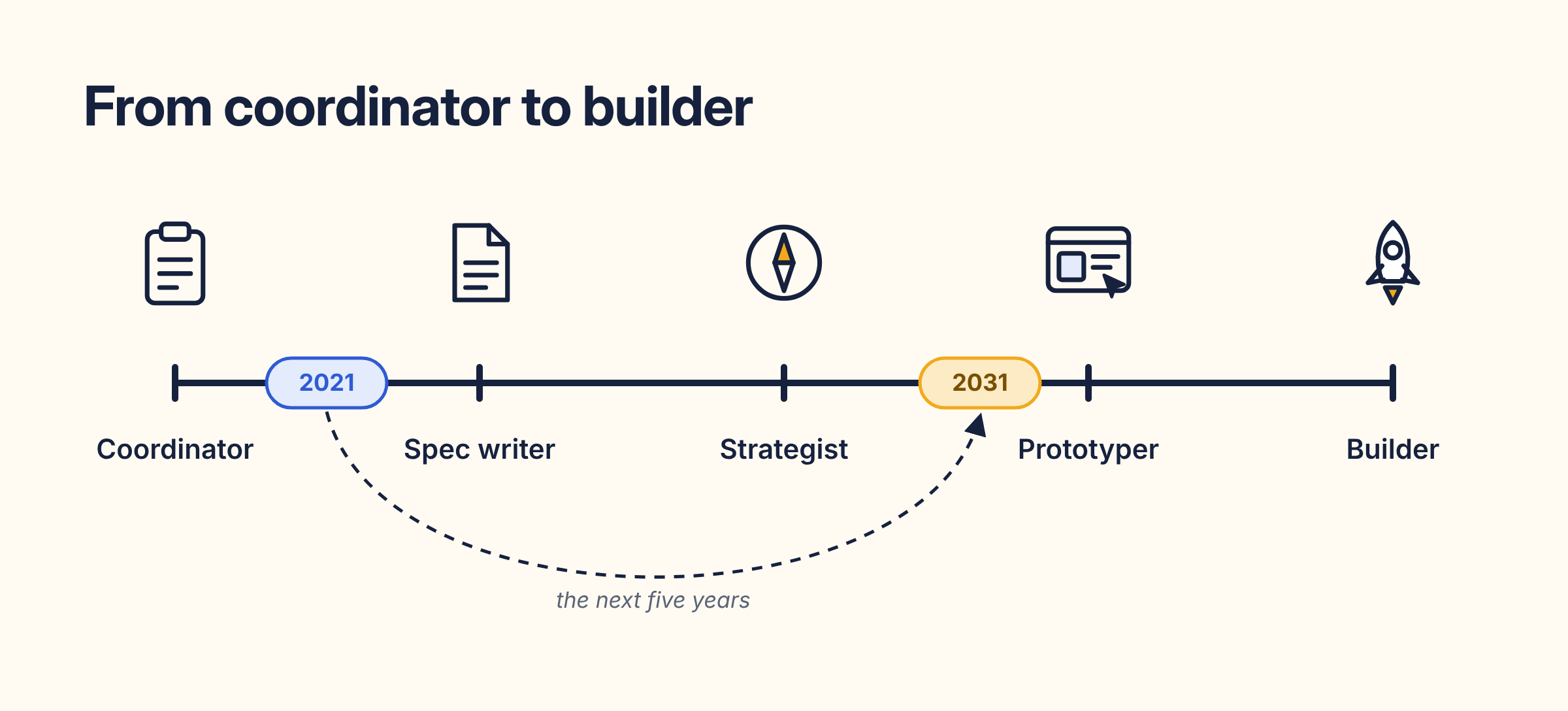
In 2021, most PMs I knew lived on the left half of this spectrum: writing tickets, running standups, chasing status updates. Many junior PMs were mostly just doing execution work (since they lacked the deeper domain or product experience to do product strategy/discovery) By 2031 I expect the default PM to sit right of center. They’ll be comfortable prototyping and shipping small things themselves, while still owning the strategy.
The far right end isn’t the goal for everyone, either. A PM who only builds and never steps back to ask why is a fast engineer with a roadmap.
3. Taste, judgment and trust become most of the job
If AI can write the spec, build the prototype and summarize the user interviews, what’s left for us? 😵💫
Quite a lot, actually. I wrote about this in Fundamental Product Management: Why it’s more important in the AI Age back in early 2025, and five years out I think it matters even more. The parts of the job that survive are the ones that need a human with context and a point of view:
Taste. AI can generate fifty versions of an onboarding flow in a minute. Someone still has to pick one, notice what’s subtly off, and defend the choice in a room full of opinions.
Judgment under ambiguity. Choosing which bet to make with incomplete data, then owning the outcome when it doesn’t go to plan.
Customer intimacy. When I was PM for Planview Copilot (now Planview Anvi), our first release didn’t land because customers couldn’t see how it fit into their day. What fixed it was a year of feedback calls and failing fast until a set of use cases stuck. No dashboard would have told us that on its own.
Trust. Engineers, designers and execs follow PMs they trust, and that trust gets built in hallway chats and hard conversations.
As ironic as it sounds, the more of the busywork AI takes on, the more your soft skills become the thing people actually hire you for.
4. You’ll manage agents as well as people
Today most PMs use AI as an assistant: summarize this call, draft that one-pager, create epics, or do data analysis. Within five years I expect PMs to run small teams of AI agents doing real work in the background. Picture a research agent synthesizing support tickets every morning, an analytics agent flagging a metric dip before standup, and a QA agent poking holes in the prototype you built last night. These things are already deployed in some teams, but they’ll eventually be fully adopted in most if not all teams.
On paper, it sounds like less work. In practice, it’s a new kind of management. Agents need clear goals, good context and honest feedback, same as people do (minus the coffee chats). The PMs who do well here will write a crisp brief for an agent, notice when its output is confidently wrong, and set up evals that catch quality drops before customers do.
Here’s how I’d split the work by 2031:
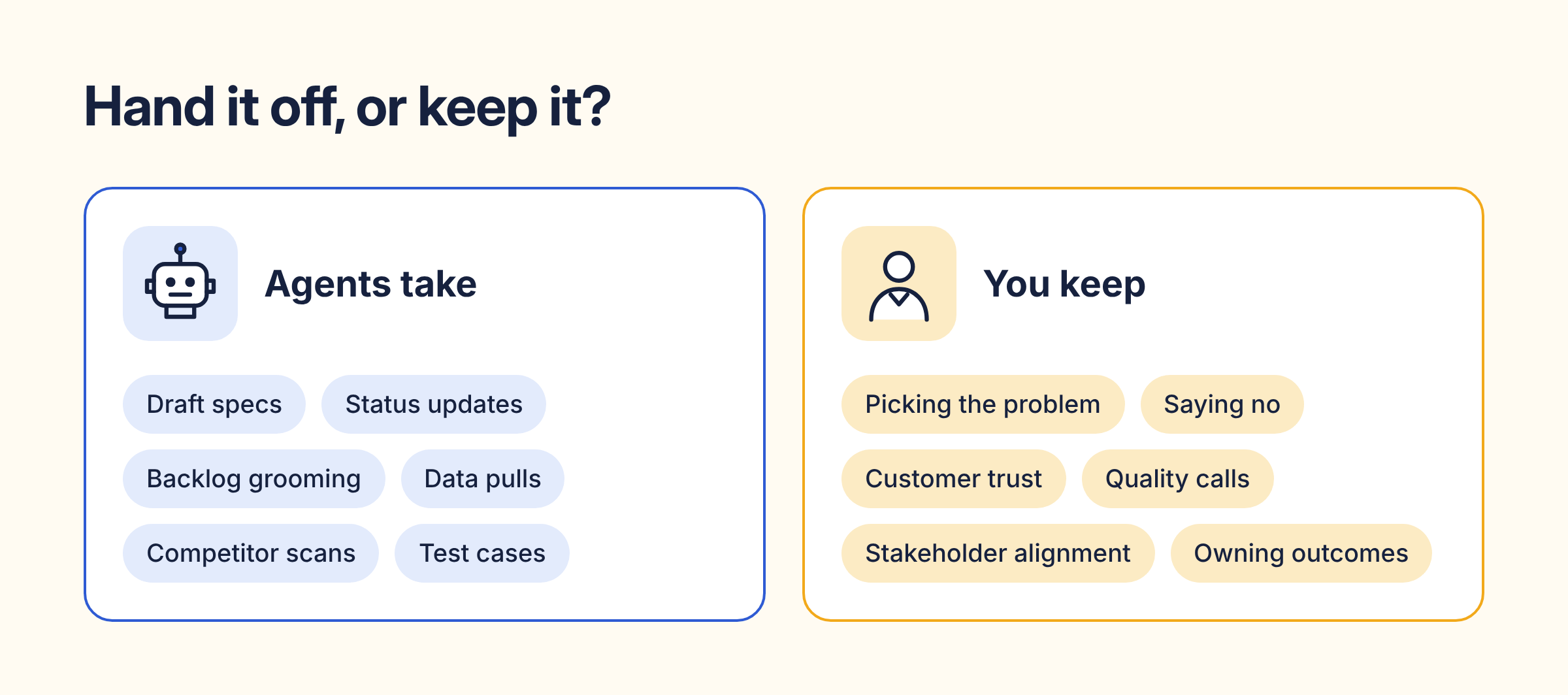
So where do you sit today?
Put two of these shifts together, how much you can build yourself and how strong your product judgment is, and you get four kinds of PMs heading into the next five years.
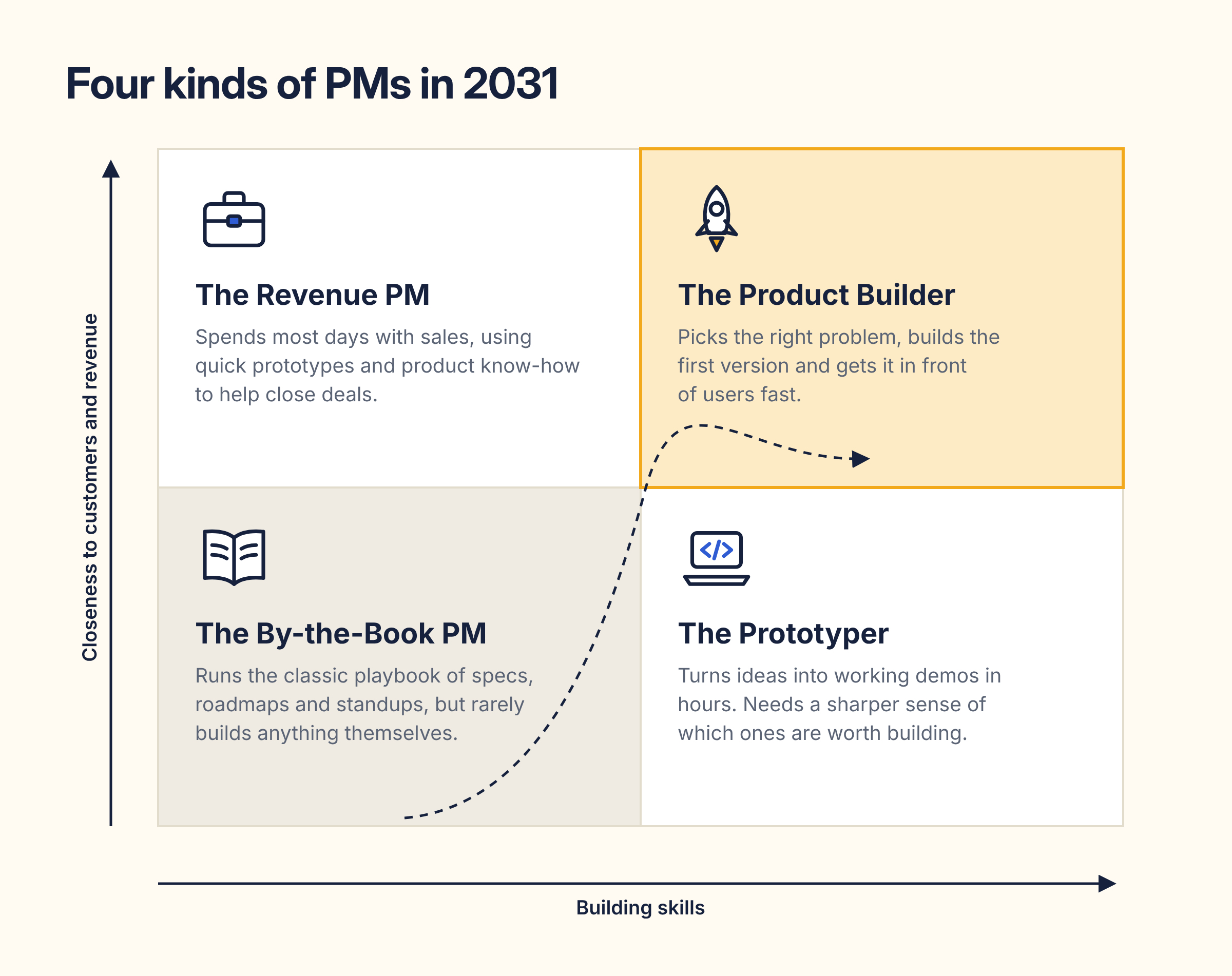
Top left, The Revenue PM: spends most days with sales, using quick prototypes and product know-how to help close deals.
Bottom left, The By-the-Book PM: runs the classic playbook of specs, roadmaps and standups, but rarely builds anything themselves.
Bottom right, The Prototyper: turns ideas into working demos in hours, but needs a sharper sense of which ones are worth building.
Top right, The Product Builder: picks the right problem, builds the first version and gets it in front of users fast. This square is still highlighted.
Most of us don’t sit neatly in one box, and that’s fine. What matters is which direction you’re moving.
How to get ready
If you’re an aspiring PM:
Keep building end to end. Use Claude Code, Cursor, Lovable or Replit to ship a small product to real users, even if it’s ten of them. A live link says more than a certificate. Continue learning new AI tools and agentic prompts.
Pick a domain and go deep. Vertical knowledge (travel, health, fintech, whatever lights you up) is how you’ll know what “good” looks like, and it’s the hardest thing for AI to fake. Domain expertise will get even more important than ever.
Get reps talking to users. Run interviews for a friend’s startup, help a nonprofit with their website, or join a community like PM Hive (😉) and practice with people who’ve done it.
Learn how LLMs behave: what they’re good at, where they hallucinate, and why evals matter.
If you’re already a PM:
Swap one doc a week for a prototype. Bring something clickable to your next review and watch how the conversation changes. Share Claude artifacts that show prototypes or ideas/workflows more often :)
Audit your calendar. Look at last week and mark every task an agent could do today. Automate the easy ones and spend the hours you get back with customers.
Own the quality bar for AI features on your team. Learn to read and write evals, and be the person who can explain why an output is wrong.
Pair with your engineers and designers instead of handing off to them. The handoff is the part of the process that’s shrinking fastest.
Double down on relationships. Influencing without authority will be a bigger share of what you’re paid for. I mean, that’s the essence of a great PM, after all.
Conclusion
Five years is a long time in tech. Five years ago most of us hadn’t heard of ChatGPT or Claude, and now it’d be weird if a PM wasn’t using them on a daily.
I won’t pretend every prediction here will strike a pin… but I am confident about the direction, though. The craft at the center of product will still be there in 2031: understanding people, picking the right problem and rallying a team around it. Almost everything around that craft will have changed, from who builds to how fast. The PMs who thrive will be the ones who start practicing now, one prototype and one customer call at a time.
If you’re figuring out your own path through all this, come grab a coffee with us at a PM Hive event in Vancouver (and soon… Montréal). I’d love to hear where you think the role is heading, especially if you disagree with me.
Follow Us!
LinkedIn: linkedin.com/company/pmhivevan
X/Twitter: x.com/PMHiveYVR
YouTube: youtube.com/@PMHive
Main site: pmhive.ca