


If you haven’t realized it yet, someone’s AI tool is more likely to read your PRD (product requirements document) before a human does, but sooner or later, PRDs are likely getting replaced.
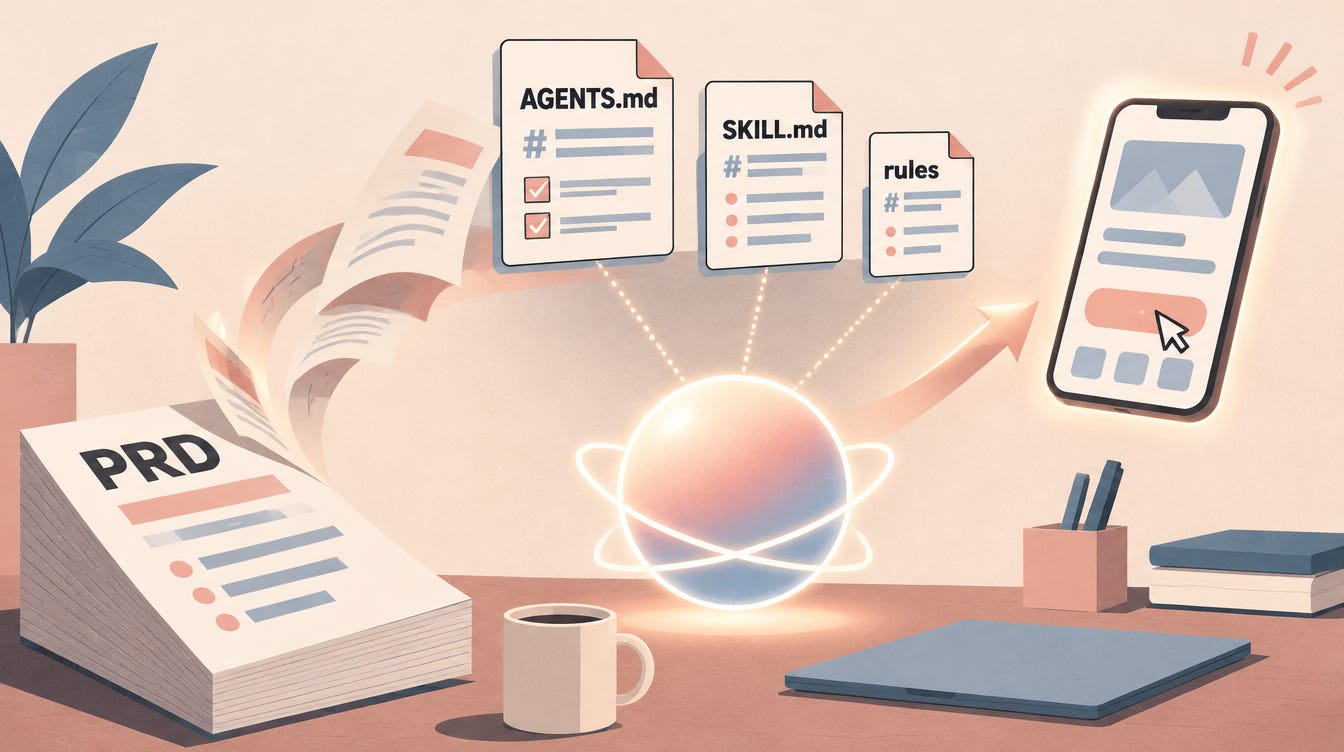
The humans, meanwhile, just wanted requirements that helped them get their work done. And more and more, that’s how ideas move at work. Someone builds a quick prototype or a Claude artifact, drops the link in Slack, and the whole conversation happens around something you can click. The long written spec is getting squeezed from both sides. People would rather look at a prototype, and agents would rather read a few short, focused files.
So I’ll say it: we’re going to write a lot fewer PRDs in the near future. The thinking inside them isn’t going anywhere, though 😉. Instead, PRD content is going to be moving into prototypes, artifacts, and markdown files like AGENTS.md and skills, which capture the same decisions in forms that people and agents actually use. These support downstream AI-enabled workflows that we’ll get into in this blog.
The numbers: PMs are building more and writing less
This isn’t just a vibe I’m getting from my LinkedIn feed or PMs around me. (Okay, partly. But not only.)
In Lenny Rachitsky and Noam Segal’s survey of 1,750 tech workers, published last December, PMs’ top uses for AI were writing PRDs (21.5%) and making prototypes (19.8%), basically neck and neck. When they were asked what they want to use AI for next, prototyping jumped to 44.4%. PMs are telling us where they’re headed, and it’s toward building instead of writing.
The big companies are already there. In April, two Uber PMs wrote that nearly 40% of submissions to Uber’s global tech hackathon used a prototyping tool. One PM explored six different concepts for a single problem in about 20 minutes, something that used to take several rounds of iteration. Another team’s summary is my favourite headline of the year: “Two Hours of Prototyping Unblocked Four Weeks of Discussion.”
At Anthropic, the Claude Code team doesn’t write PRDs at all actually. As Aakash Gupta described it in March, the culture there is “better send a PR.” Over at ServiceNow, PM Sriram Kothandaraman spent six hours writing an epic by hand, then built the same feature in Claude Code in one hour. His engineering manager liked the prototype more than the doc 😂. In Sriram’s words: “Building is now cheaper than writing about building.”
Everyone else is building too. By mid-2025, Anthropic said millions of people had already made more than half a billion Claude artifacts. In UX Tools’ spring 2026 survey of 1,478 designers and builders, 59.1% had built their own tool, app, or utility with AI in the past six months.
Microsoft CPO Aparna Chennapragada saw this coming back in May 2025, when she told Lenny’s Podcast: “If you’re not prototyping and building to see what you want to build, I think you’re doing it wrong.”
Why the prototype/artifact wins the room
A PRD asks everyone to imagine the same product from the same paragraphs. They rarely do. The designer pictures one thing, the engineer pictures another, and the VP skims the summary and pictures whatever they wanted in the first place. A prototype or artifact skips that step, because everyone is looking at the same screen and visualized workflow.
We’ve been exploring this a lot at Stay22. Artifacts have become one of our main ways of showing people an idea: a new concept, a workflow or process change, or a case for what should go on the roadmap. Instead of writing it up and hoping everyone pictures the same thing, someone builds a quick artifact and shares the link. People click around, poke holes, and react to the real thing.
My favourite part is what it does to the conversation. A doc tends to get “looks good to me” but rarely does it prove your primary stakeholders are aligned or know exactly what’s going on in your head. A prototype gets “wait, what happens if I click this?” That second question is where the real product work starts. Roadmap planning gets better too, since it’s easier to see and visualize potential impact — not to mention getting more people aligned in the same room (which is arguably one of the hardest PM tasks).
When I gave the opening keynote at UBC’s Product Teardown this fall, one of my tips for the students was “Guesses are fine. Label them as guesses.” A prototype is a labelled guess you can click. It’s honest about being unfinished, and it’s cheap enough to throw away when you’re wrong. Assumptions are fine to make — you just need to ensure they’re called out.
Where the rest of the PRD went
A prototype shows what the product looks and feels like. But a good PRD also holds the stuff you can’t see: the why, the constraints, the trade-offs, the definition of done. That part is moving into context files, which are small markdown files that an AI agent reads before it does any work.
The tools caught up fast. OpenAI released AGENTS.md in August 2025, a plain markdown file that works like a README for agents. By December, it was in more than 60,000 open source projects, and OpenAI donated it to the Linux Foundation’s new Agentic AI Foundation, which it co-founded with Anthropic and Block. That same month, Anthropic opened up its Agent Skills format, and Cursor, VS Code and GitHub adopted it. GitHub’s Spec Kit and AWS’s Kiro are both built on writing the spec first and letting the agent build from it, which people now call spec-driven development.
Put it all together, and the PRD hasn’t disappeared so much as been split into pieces, each living where its reader will find it:
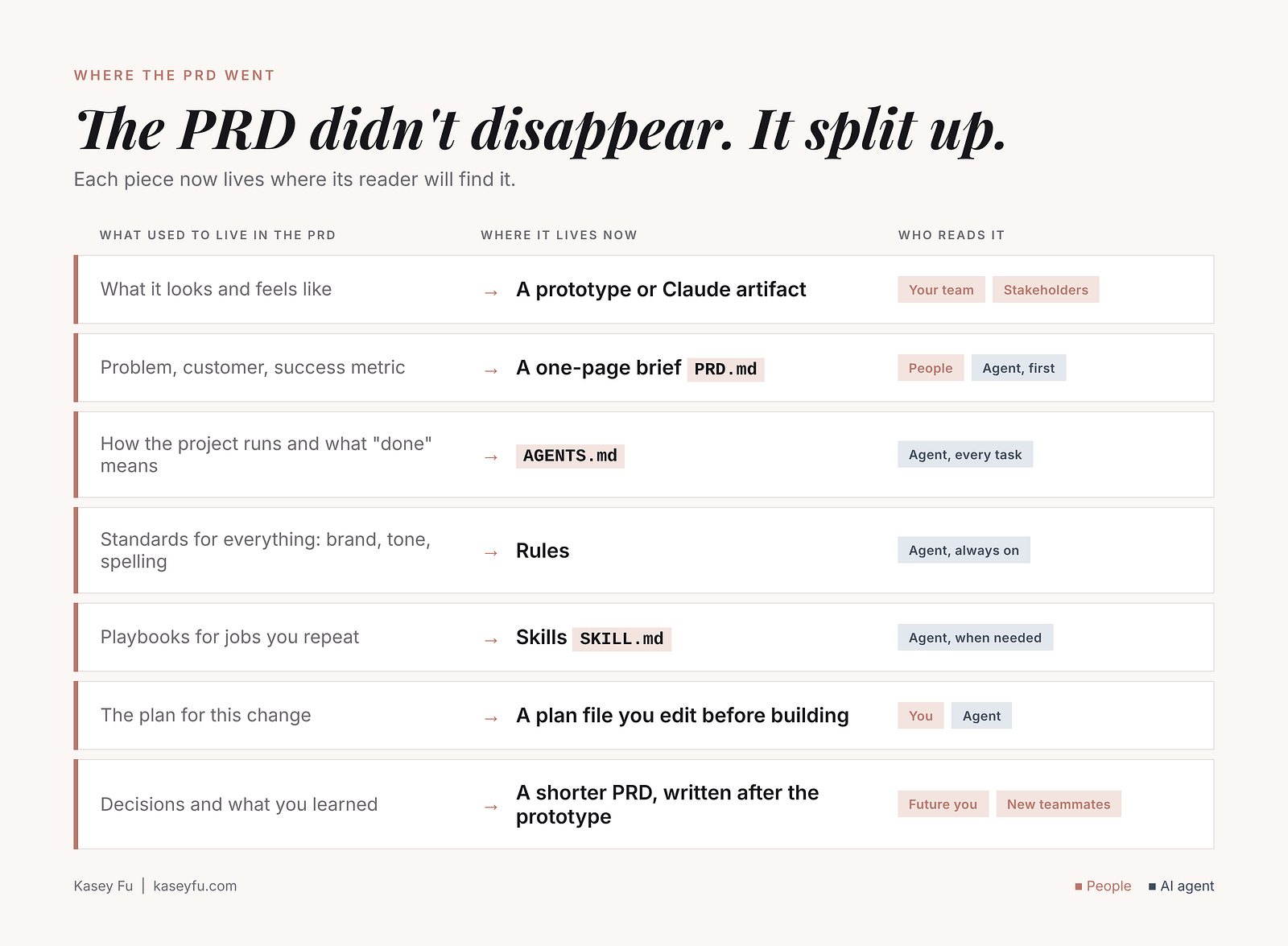
None of these files are long. In the demo app we built at our PM Hive Cursor workshop, the brief was 1.5 KB, and the AGENTS.md was 710 bytes. Small is the point, so we save both context window space and token cost.
Why PRDs will be hard to 100% phase out
Not everyone is ready to hold the funeral just yet though 😛. Those same Uber PMs titled one section “Prototyping Didn’t Kill the PRD, It Became Its Sidekick.” They still recommend writing the PRD first for mobile-first products, compliance-heavy domains, and mature products where one change ripples everywhere. That’s fair. If you work in certain restrictive industries (like banking or healthcare), a clickable demo isn’t going to get past legal requirements or set sources of truth in a proper location for people to refer back to.
Others are skeptical of all the markdown. In February 2026, ETH Zurich researchers tested whether AGENTS.md files help coding agents. Files written by an LLM made agents slightly worse (success rates down 0.5% to 2%). Files written by developers helped a little (up about 4%). Both raised costs by more than 20%, and the codebase overviews everyone loves to include didn’t help at all.
So a bad context file is worse than no file. From that research and my own fumbling, a few things seem to separate the good ones:
Write down what the agent can’t guess. It can see your folders, so skip the tour. It can’t know your price in Canadian dollars or that a legal disclaimer can never be removed.
Say what done looks like. “The build passes, and you’ve checked it in the browser” beats “make it work.”
Add a rule only after the agent makes the same mistake twice. Otherwise, the file bloats with fixes for problems you never had.
Write the PRD after the prototype. Let the prototype settle the debates, then use a short doc to record what you decided and why.
The part an agent can’t write for you
I opened that UBC keynote with a $400 Wi-Fi juicer. Juicero raised about $120 million, and then Bloomberg showed you could squeeze its juice packs by hand and get about the same amount of juice. The company shut down in 2017. Smart team; real money; wrong problem.
Juicero needed years and a factory to build the wrong thing. Today you can build the wrong thing before lunch. When anyone can ship a feature in an afternoon, the scarce skill is knowing which ones to skip. Aakash Gupta put it bluntly: “Without taste, speed just means you build the wrong thing faster.” Even Boris Cherny, who leads Claude Code, admits that “half my ideas are bad and you just have to try stuff.” The trying is cheap now. Deciding what survives is the job.
That’s why taste belongs in your context files. Every trade-off you write down, like “speed over polish” or “no calendar integration yet,” is a decision about what not to build, and the agent reads it every time it starts work. Leave those lines out, and it’ll cheerfully build everything. That’s the part of the PRD that never goes away, and I’d argue it was always the most important part. A PM ultimately still exists to determine both taste and sensibility. We still need to determine if a product idea makes sense to build (is it viable, feasible, and usable?). Sometimes, a PRD will capture that better still than a prototype or artifact.
So, is the PRD going to be gone soon?
Kind of... slowly but surely. The five-page doc nobody finished reading is on its way out, and I won’t miss it. What’s replacing it is smaller and more useful: a prototype or artifact people can click, a handful of files an agent reads before it touches anything, and a short doc that records what you decided.
If you want to try it, take the next idea you’d normally write up and build a rough artifact first. Share the link instead of the doc and watch what kind of questions you get. Then write down the three or four things you’d want an agent to know before it touched the idea. Congrats, that’s your first context file.
And if you build something, bring it to the next PM Hive Coffee Social. I want to see it.
Sources
Lenny Rachitsky and Noam Segal: AI tools are overdelivering (survey of 1,750 tech workers), December 23, 2025
Aayush Agrawal and Akanksha Sharma: AI prototyping is changing how we build products at Uber, April 15, 2026
Aakash Gupta: There’s a new PM skill. It’s called taste at speed, March 13, 2026
Sriram Kothandaraman: Be a product builder, period (Mind the Product), May 19, 2026
Anthropic: Turn ideas into interactive AI-powered apps (half a billion artifacts), June 25, 2025
Lenny’s Podcast: Aparna Chennapragada on prototyping and prompt sets, May 18, 2025
OpenAI: Agentic AI Foundation announcement (AGENTS.md adoption), December 9, 2025
VentureBeat: Anthropic opens the Agent Skills standard, December 18, 2025
Birgitta Böckeler: Understanding spec-driven development, October 15, 2025
Gloaguen et al., ETH Zurich: Evaluating AGENTS.md, February 2026, with DAIR.AI’s summary of the numbers